
You walk into a medical office and feel that familiar tightening in your chest, wondering if you'll be forced to recount your most painful memories just to get the help you need. It's a common fear, and for many, the traditional clinical environment feels more like an interrogation than a place of sanctuary. You deserve to feel seen as a whole person rather than just a collection of symptoms or a number on a chart.
This is why trauma-informed psychiatric care is fundamentally changing the way we approach mental wellness in 2026. This framework prioritizes your safety and personal agency, ensuring your history is respected without requiring you to relive it. You'll discover how this compassionate approach shifts the focus from "what's wrong with you" to "what happened to you." We'll explore how collaborative medication management and a deep understanding of the mind-body connection provide a stable, supportive path toward the relief you deserve.
Key Takeaways
- Understand how shifting the clinical focus from "what is wrong" to "what happened" creates a safer, more validating space for your healing.
- Learn how trauma-informed psychiatric care adapts medication management to account for your body's unique sensitivities and emotional boundaries.
- Discover how to vet psychiatric providers in Massachusetts and Rhode Island to ensure your treatment plan is truly collaborative and patient-centered.
- Explore how telehealth options can provide a secure and flexible way to access expert care without the stress of traditional clinical environments.
Understanding Trauma-Informed Psychiatric Care: Beyond the Symptoms
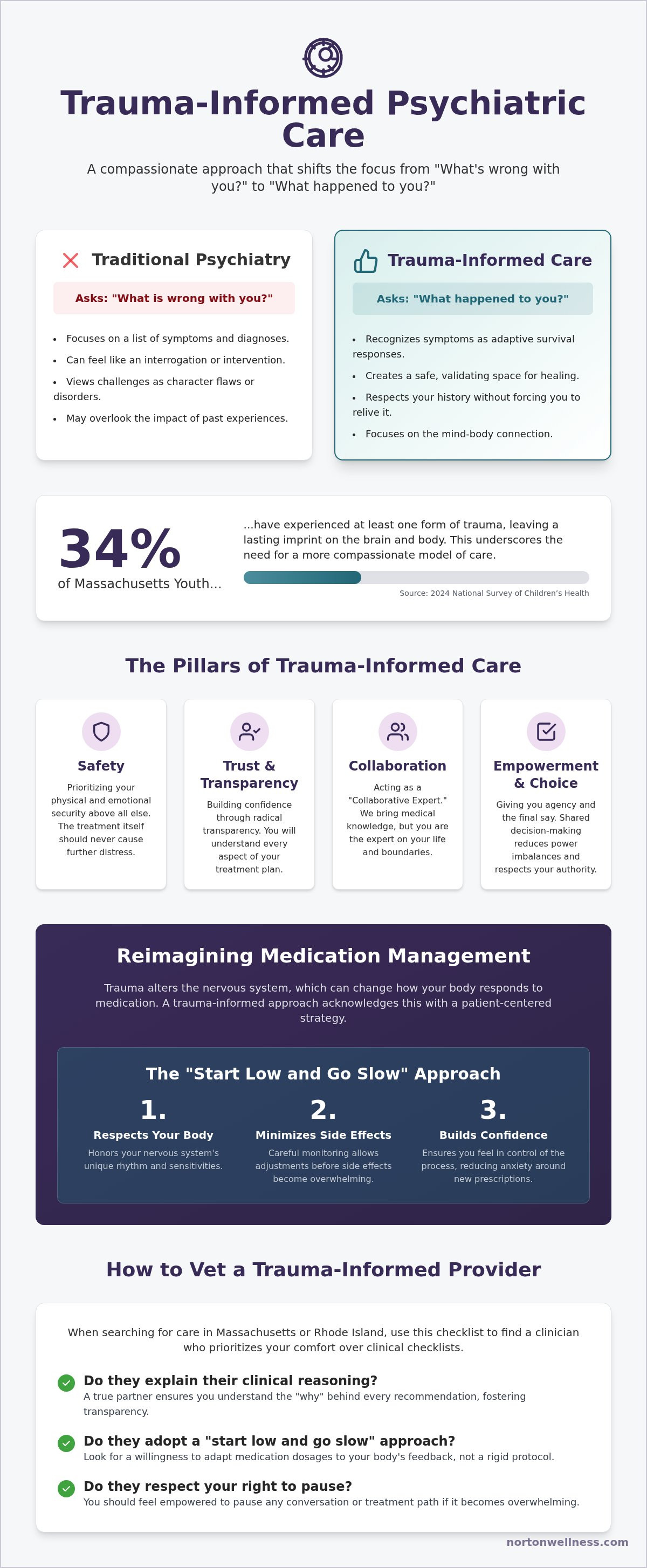
Traditional medicine often asks, "What is wrong with you?" and focuses on a list of symptoms or diagnoses. In contrast, Trauma-Informed Care asks a much more compassionate question: "What happened to you?" This shift in perspective is the foundation of trauma-informed psychiatric care. It recognizes that your current mental health challenges aren't flaws in your character; they're often adaptive responses to past experiences. With 34% of Massachusetts youth having experienced at least one form of trauma according to the 2024 National Survey of Children’s Health, it's clear that these experiences leave a lasting imprint on both the brain and the physical body, influencing everything from your stress response to your immune system.
You might worry that starting treatment means you'll be forced to relive your darkest moments during an intake. We want you to know that healing doesn't require you to "re-tell" your story until you're ready. Instead of a sterile clinical intervention, we act as a "Collaborative Expert." This means we bring specialized medical training to the table, but you remain the expert on your own life and boundaries. We work with you, not on you, ensuring you maintain control over your path to wellness.
The Core Principles of Safety and Trust
Your sense of safety is our highest priority. In a psychiatric setting, this means creating an environment where you feel physically secure and emotionally heard. We build trust through radical transparency, ensuring you understand every aspect of your treatment plan before we move forward. Trauma-informed care is a clinical commitment to ensuring the treatment process itself never becomes a source of further distress. By prioritizing clear communication and patient agency, we transform the clinical experience into a genuine partnership within the framework of trauma-informed psychiatric care. If you're ready to explore this approach, you can reach out to our team to begin your journey.
How Trauma-Informed Principles Shape Medication Management
Trauma isn't just a memory; it's a physiological state that can alter how your body responds to treatment. Traditional psychiatry sometimes overlooks how a hyper-vigilant nervous system processes medication, but trauma-informed psychiatric care acknowledges this reality. People with trauma histories may experience heightened sensitivity to side effects or feel a sense of loss of control when starting a new prescription. We prioritize your comfort by listening to your physical and emotional feedback. Whether we are discussing medications for anxiety and depression or managing other conditions, the process is a dialogue, not a directive.
Empowerment is the cornerstone of this approach. You always have the final say in your treatment journey because you are the authority on your own body. This collaborative spirit is especially vital in addiction treatment, where substance use is often a coping mechanism for underlying pain. By integrating medical expertise with a deep respect for your history, we help you find stability without feeling pressured. For those seeking a deeper understanding of these connections, SAMHSA's trauma and violence resources provide valuable context on how trauma affects long-term health and recovery.
Choice, Collaboration, and Empowerment in Treatment
We use shared decision-making to reduce the power imbalance often felt in medical offices. Our "start low and go slow" approach respects your nervous system's unique rhythm, allowing us to monitor your progress carefully without overwhelming your system. We encourage you to ask questions, voice your concerns, and set boundaries. This active participation is what makes trauma-informed psychiatric care truly effective. If you're ready for a provider who listens as much as they prescribe, reach out to us today to discuss your options.
Finding Trauma-Informed Care in Massachusetts and Rhode Island
Finding the right provider in cities like New Bedford, Fall River, or Providence shouldn't feel like another hurdle in your journey. When searching for trauma-informed psychiatric care, it's essential to look for clinicians who prioritize your comfort over clinical checklists. You can use this checklist to vet potential partners:
- Do they explain the clinical reasoning behind every recommendation?
- Are they willing to "start low and go slow" with medication dosages?
- Do they respect your right to pause a conversation if it becomes overwhelming?
For many in our region, telehealth mental health services offer a significant advantage. Virtual care allows you to remain in a safe, familiar environment, which can lower the anxiety often associated with sterile clinic waiting rooms. This modern approach aligns with the principles of Trauma-Informed Care for Health Care Workers, focusing on minimizing potential triggers while maximizing access to expert support. Norton Wellness provides this flexible, compassionate option for adults across Massachusetts and Rhode Island, ensuring you don't have to travel far for specialized care.
What to Expect During Your First Evaluation
Your first visit isn't an interrogation; it's the beginning of a partnership. As your "Compassionate Guide," we focus on your current goals and immediate needs rather than demanding a full disclosure of your past history. We'll discuss the logistics of your care, including insurance coverage and how our telehealth platform works. This patient-paced evaluation ensures you feel secure from the very first minute of your trauma-informed psychiatric care. If you're ready to experience a different kind of medicine that respects your boundaries, you can schedule a consultation with us today.
Embracing a New Standard for Mental Wellness
Choosing a path toward stability shouldn't feel like a sacrifice of your comfort or autonomy. By prioritizing trauma-informed psychiatric care, you're choosing a framework that respects your history while ensuring your current treatment remains safe and effective. This approach ensures collaborative medication management honors your boundaries while modern telehealth options make expert support accessible across Massachusetts and Rhode Island. Led by Vanessa C. Nyamunda, PMHNP-BC, our practice focuses on building a partnership where you're a person first. You deserve a provider who listens to your story and works alongside you to achieve lasting emotional relief.
Schedule your compassionate evaluation with Norton Wellness today.
Take the next step toward a future where your healing is guided by expertise and defined by your own agency. We're ready to walk this journey with you.
Frequently Asked Questions
Do I have to talk about my past trauma in a trauma-informed psychiatric visit?
No, you don't have to recount your past experiences to receive help. While knowing your history can be useful, we focus on your current symptoms and your personal goals for wellness. You're always in control of what you share and when you share it. This ensures that your visits remain a place of safety rather than a source of new stress.
How is trauma-informed care different from regular psychiatry?
Traditional psychiatry often focuses on "what's wrong with you" to find a diagnosis. In contrast, trauma-informed psychiatric care shifts that focus to "what happened to you," acknowledging how past stress impacts your physical and mental health today. It's a collaborative partnership where we prioritize your agency and nervous system stability rather than just managing a checklist of symptoms in a sterile office.
Can trauma-informed medication management help with ADHD?
Yes, we use this approach to provide ADHD treatment for adults who may also have a history of stress or trauma. Because trauma symptoms can sometimes mimic or complicate ADHD, a trauma-informed perspective helps us fine-tune your medication management. We "start low and go slow" to ensure your treatment supports your focus without causing unnecessary anxiety or physical discomfort.
Is trauma-informed care available through telehealth in Rhode Island and Massachusetts?
Absolutely. Norton Wellness offers telehealth appointments for adults throughout Massachusetts and Rhode Island. You can receive trauma-informed psychiatric care from your home in New Bedford, Fall River, Taunton, or Providence. This virtual option is often preferred by those who find traditional clinic settings triggering, as it allows you to stay in a familiar environment while working toward stability with a compassionate guide.


