
Imagine waking up with a heavy weight on your chest, knowing you need help, but the thought of driving through traffic or sitting in a crowded waiting room feels impossible. For many, the very symptoms of mental health struggles are the biggest barriers to receiving care. It's exhausting to manage social anxiety or depressive fatigue while trying to find telehealth for anxiety and depression that actually feels personal. You deserve a path to wellness that meets you exactly where you are.
This 2026 guide explains how specialized virtual care can bridge the gap between struggling and healing from your home in Rhode Island. We'll explore how virtual medication management works, the latest regulations ensuring your safety, and how to connect with a trusted local provider who views your recovery as a collaborative journey toward stability.
Key Takeaways
- Discover how telehealth for anxiety and depression removes the burden of travel and waiting rooms, allowing you to prioritize your healing in a safe, familiar environment.
- Learn what to expect during a 60-minute virtual psychiatric evaluation and how collaborative goal-setting ensures your treatment plan aligns with your personal needs.
- Understand why choosing a provider licensed specifically in Rhode Island and Massachusetts is vital for accessing localized support and specialized medication management.
- Explore how a patient-centered "Collaborative Expert" model transforms the therapeutic process into a partnership focused on long-term emotional stability.
The Role of Telehealth in Managing Anxiety and Depression
Telepsychiatry serves as a secure, HIPAA-compliant video connection specifically designed for psychiatric evaluation and ongoing treatment. It's much more than a simple video call; it's a clinical tool that allows you to receive expert care without the stress of a commute. Using telehealth for anxiety and depression provides a "safe space" where you can be vulnerable from the comfort of your own home. This privacy often encourages a deeper level of honesty during sessions, which is vital for an accurate diagnosis and an effective treatment plan.
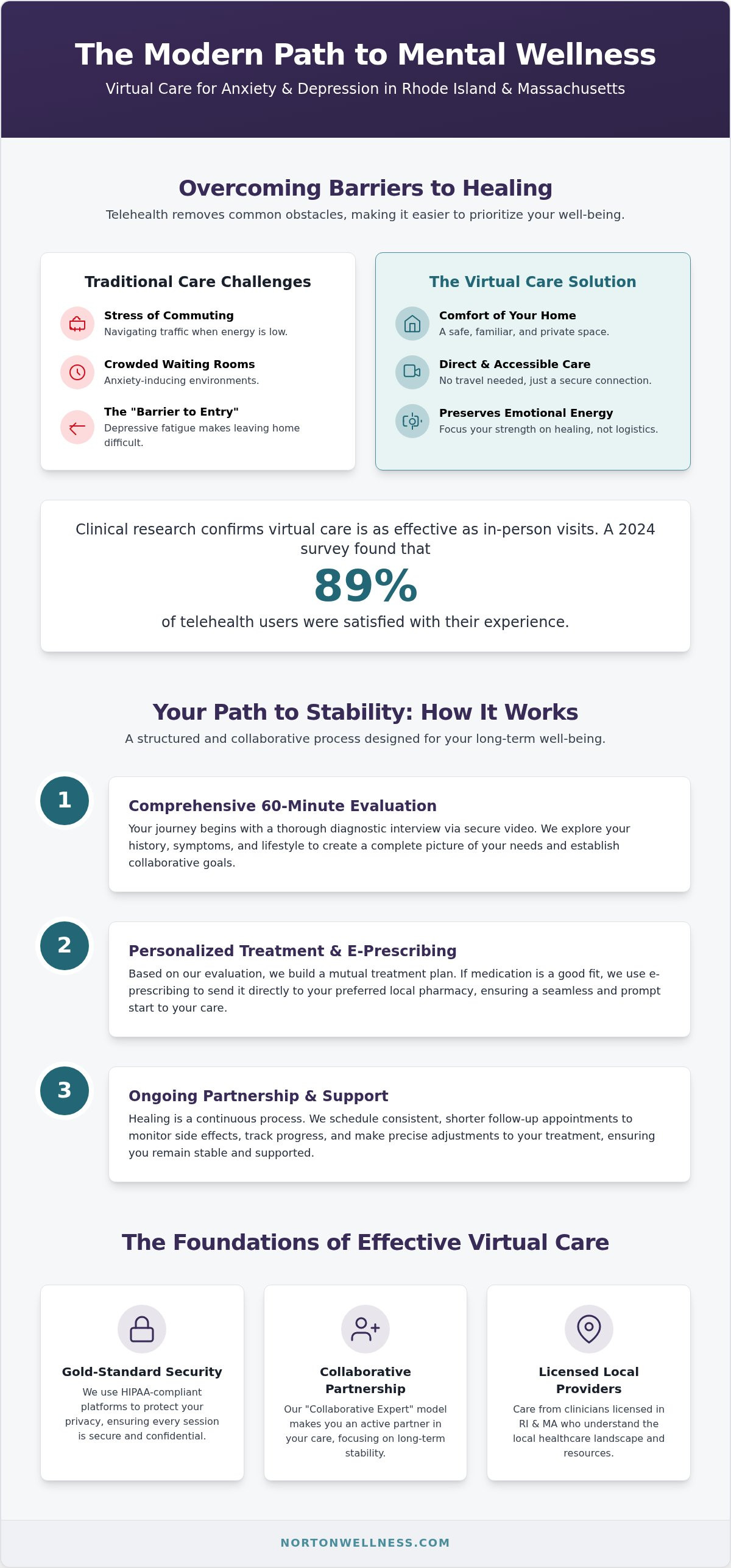
For many adults, the simple act of leaving the house is the most daunting part of the day. Virtual care directly addresses this "barrier to entry" by eliminating the need to navigate traffic or sit in a crowded waiting room. It preserves your limited emotional energy for the actual work of healing rather than the logistics of getting to an office.
To better understand this concept, watch this helpful video:
Clinical research confirms that virtual psychiatric care is just as effective as traditional in-person visits for managing mood disorders. A 2024 survey found that 89% of telehealth users were satisfied with their experience, frequently preferring it due to its accessibility. This means you aren't sacrificing quality for convenience. Instead, you're choosing a modern approach that respects your time and your emotional state.
Why Virtual Care is Often the Best First Step for Emotional Struggles
When you're struggling with depressive fatigue, even a short drive can feel like an impossible marathon. Telehealth for anxiety and depression acts as a vital lifeline, ensuring that help is always within reach regardless of your energy levels. This accessibility makes it much easier to maintain consistent follow-up appointments, which is the cornerstone of stabilizing mood disorders and achieving long-term wellness. If you're interested in a deeper analysis of how clinical symptoms are integrated into your care, explore our guide on working with an Anxiety and Depression Psychiatrist.
How Psychiatric Medication Management Works via Telehealth
Your journey begins with a comprehensive 60-minute initial psychiatric evaluation conducted via secure video. This isn't a rushed appointment. It's a thorough diagnostic interview where we explore your history, symptoms, and lifestyle. We focus on a collaborative goal-setting process, ensuring that any decision regarding medication management is a mutual one. We'll discuss if medication is the right path for your specific needs or if other strategies might better serve your recovery. Using telehealth for anxiety and depression allows us to build this foundation of trust in a setting where you feel most comfortable.
Once we decide on a plan, the logistics are simple. We use e-prescribing to send your medications directly to your preferred local pharmacy in Providence or East Providence. This ensures your treatment starts without unnecessary delays. After your initial visit, we establish a consistent follow-up rhythm. These shorter, recurring check-ins allow us to monitor side effects, track progress, and adjust dosages with precision. It's a continuous partnership designed to keep you stable. Using telehealth for anxiety and depression ensures your care is both high-quality and accessible.
Safety, Privacy, and Efficacy of Remote Prescribing
We utilize HIPAA-compliant platforms as the gold standard for protecting your psychiatric privacy. Some worry that online care is less thorough, but we use standardized screening tools for anxiety and depression to ensure every clinical decision is data-driven. This approach provides the same level of diagnostic rigor as an in-person visit. If you're looking for more details on local regulations, you can learn more about Telehealth Mental Health in Rhode Island. When you feel ready to take the next step, you can schedule a consultation to discuss your needs.
Finding Your Path to Healing in Rhode Island and Massachusetts
Choosing a provider licensed in Massachusetts or Rhode Island is more than a legal requirement. It ensures your clinician understands the local healthcare landscape and the specific community resources available to you in the region. Whether you live in Central Falls or a quiet suburb in Massachusetts, telehealth for anxiety and depression offers a flexible tool that adapts to your daily life. It removes the stress of a long commute, allowing you to focus entirely on your mental well-being instead of traffic. This local connection builds a foundation of trust and reliability that generic national platforms often lack.
At Norton Wellness, Vanessa C. Nyamunda, PMHNP-BC, operates as a "Collaborative Expert." This approach means her specialized training is used in direct service of your unique emotional needs. We view psychiatric care as a partnership rather than a one-sided clinical intervention. Your voice matters in every decision. To prepare for your first session, find a quiet, private space where you feel safe and secure. It's helpful to list your current symptoms and long-term goals beforehand to ensure we address your concerns with clarity and purpose. Using telehealth for anxiety and depression ensures this process remains non-judgmental and patient-centered.
What to Expect During Your Initial Consultation at Norton Wellness
The onboarding process is designed to be simple and stress-free, respecting the energy it takes to reach out for help. You can start by using our contact widget to share your information. From there, we'll schedule your first video call, which serves as the beginning of our collaborative journey toward stability. For residents in the Providence area, this virtual connection provides world-class expertise without the frustration of navigating downtown traffic or parking. Our goal is transformation and relief, ensuring you feel heard, validated, and supported from the very first moment we connect.
Moving Toward a Brighter, Balanced Future
Healing isn't a destination you have to reach alone. It's a continuous process of growth and stabilization. By choosing telehealth for anxiety and depression, you prioritize your well-being without the added stress of travel or clinical waiting rooms. Our practice offers a patient-centered, collaborative approach led by a Board Certified Psychiatric Mental Health Nurse Practitioner licensed in both Massachusetts and Rhode Island. We don't just provide prescriptions; we build a partnership focused on your unique emotional relief and long-term clarity. You have the power to bridge the gap between struggling and thriving from the safety of your own home.
Schedule your telehealth consultation with Norton Wellness today.
You deserve a steady partner who's invested in your journey toward emotional health. We're ready to listen and act whenever you feel ready to take that first step.
Frequently Asked Questions
Is telehealth for anxiety and depression covered by insurance?
Yes, telehealth for anxiety and depression is generally covered by most major insurance plans in Massachusetts and Rhode Island. Norton Wellness accepts insurance and online payments to keep care accessible for our patients. It's always a good idea to verify your specific plan's copay, which often ranges from $15 to $50 per session depending on your provider and network status.
Can a telehealth psychiatrist prescribe medication for depression and anxiety?
Yes, a board certified psychiatric mental health nurse practitioner can evaluate your symptoms and e-prescribe medications directly to your local pharmacy. At Norton Wellness, we send prescriptions to pharmacies in Providence, East Providence, and throughout the region. This process is secure and follows all state regulations for remote prescribing, ensuring you receive your treatment without needing to visit an office in person.
What do I need for my first virtual psychiatric appointment?
You only need a stable internet connection and a private, quiet space where you feel comfortable discussing your mental health. Most patients use a smartphone, tablet, or computer with a working camera and microphone. We recommend having a list of your current symptoms and any specific goals for your care. This preparation helps us make the most of our initial 60-minute diagnostic interview together.
Is virtual medication management as effective as in-person visits?
Clinical research consistently shows that virtual medication management is just as effective as in-person care for treating mood disorders. Telehealth for anxiety and depression offers the same diagnostic rigor while providing the added benefit of reduced travel stress. Many adults find that receiving care in a familiar environment makes it easier to be open and vulnerable, leading to more accurate assessments and better long-term results.


