
What if the missing piece to your mental wellness isn't just a listening ear, but a medical partner who understands exactly how your brain's biology impacts your daily joy? It's common to feel a sense of hesitation when your symptoms, whether they're the persistent fog of depression or the scattered energy of ADHD, begin to feel like too much to carry alone. You might worry about being over-medicated or feel anxious about walking into that first appointment without knowing what does a psychiatrist do to help you navigate these challenges. Many of our neighbors in New Bedford and Providence share these exact fears, often feeling lost in a sea of different provider titles and treatment options.
We believe that reaching out is a brave act of self-care. You deserve a path toward stability that feels both professional and deeply personal. This guide will help you discover how a psychiatrist serves as a compassionate guide, combining advanced medical expertise with a patient-centered approach. We'll explore the difference between various mental health roles, walk you through the initial evaluation process, and show you how a collaborative partnership can lead to genuine emotional relief and lasting growth.
Key Takeaways
- Learn exactly what does a psychiatrist do to bridge the gap between biological medicine and mental wellness through expert diagnosis and specialized medication management.
- Gain clarity on how psychiatric care addresses complex conditions like Adult ADHD and addiction, using tools like Suboxone to support your recovery journey.
- Discover the critical differences between a psychiatrist and a psychologist so you can choose the right specialist for your unique emotional and biological needs.
- Prepare for your first consultation with confidence by knowing what to expect during a psychiatric evaluation, whether you're visiting in person or via telehealth.
- Find out how a trauma-informed, patient-centered approach creates a collaborative partnership that prioritizes your stability and personal growth.
What is a Psychiatrist? The Bridge Between Medicine and Mental Wellness
A psychiatrist or psychiatric provider acts as a vital link between the biological complexities of the human brain and the emotional nuances of daily life. While many people wonder what does a psychiatrist do beyond writing prescriptions, the reality is far more holistic. Psychiatry is a specialized medical field that treats mental health as an integral part of physical health. It's about understanding how your sleep, appetite, and energy levels are deeply connected to your mood and focus.
The old stereotype of a detached doctor in a sterile office is fading. In its place is a modern, supportive partnership. This medical specialty provides the unique ability to diagnose complex conditions while simultaneously monitoring your physical well-being. It's a critical component of care that helps you move from simply managing symptoms to achieving true emotional clarity. When you ask, what does a psychiatrist do to change your daily experience, the answer lies in their specialized ability to look at you as a whole person rather than just a list of symptoms.
The Clinical Foundation: MDs, DOs, and PMHNPs
Understanding the different types of providers is the first step toward feeling secure in your care. While MDs and DOs are medical doctors, Psychiatric Mental Health Nurse Practitioners (PMHNPs) like Vanessa C. Nyamunda play an equally essential role in modern mental health. PMHNPs are advanced practice nurses with specialized training in psychiatric diagnosis and medication management. They provide high-level care that is both clinically rigorous and deeply empathetic.
Managing psychiatric medications requires a deep understanding of pharmacology and how different treatments interact with your unique body chemistry. PMHNPs undergo extensive clinical hours to master these nuances. This expertise allows them to adjust dosages and select medications that minimize side effects while maximizing emotional relief. It's a balance of science and empathy. At Norton Wellness, we use this clinical foundation to create a non-judgmental environment. We prioritize active listening and patient-centered strategies, ensuring that every treatment plan respects your personal goals and your biological needs.
Why Seek a Psychiatric Specialist?
You might find yourself wondering if your struggles are "serious enough" for a specialist. If symptoms like anxiety, depression, or ADHD start to interfere with your ability to work or maintain relationships, it's time for a professional perspective. A psychiatric provider helps you distinguish between situational emotional distress and biological imbalances that may require medical support. This intervention is about more than just relief; it's about transformation.
Consider seeking a specialist if you experience:
- Persistent symptoms that don't respond to talk therapy alone.
- Difficulty managing daily tasks due to ADHD or executive dysfunction.
- A need for specialized medication management for anxiety or depression.
- Complex emotional challenges that require a trauma-informed medical perspective.
When you work with a specialist, you're no longer just surviving each day. You're building a foundation for thriving. By identifying the root causes of your symptoms, we help you find the stability needed to reclaim your life. Whether you're in New Bedford, Providence, or connecting via telehealth, this expert care provides a clear path forward.
The Daily Work: How a Psychiatric Provider Supports Your Recovery
Psychiatric care is a dynamic process that evolves as you do. While the initial question of what does a psychiatrist do often centers on prescriptions, the daily reality is a rigorous commitment to tracking your clinical progress and validating your emotional state. Your provider acts as a dedicated observer, looking for patterns in your mood, energy, and cognitive function that might be invisible to the naked eye. This collaborative work ensures that your treatment stays aligned with your personal goals, adjusting as your life circumstances change.
Recovery isn't a straight line. It requires a safe space where you can be honest about your struggles without fear of judgment. By combining objective clinical data with your subjective experience, a psychiatric provider builds a bridge toward stability. This partnership involves constant monitoring of medication efficacy and a proactive approach to your well-being. It's about ensuring you feel heard while receiving the highest standard of medical care.
Diagnostic Evaluations: More Than a Checklist
Your journey typically begins with a comprehensive psychiatric evaluation, which usually lasts about 60 minutes. This isn't just a quick screening; it's a deep dive into your history and biology. We explore family genetics, lifestyle factors, and previous medical experiences to build a complete picture of your mental health. According to the American Psychiatric Association’s overview of What is Psychiatry?, this thorough assessment is what allows a provider to create a truly personalized treatment plan. A diagnosis provides a roadmap for healing, not a label.
If you're ready to gain this kind of clarity, our psychiatric medication management can help you start that conversation with confidence. We focus on understanding the "why" behind your symptoms, ensuring that every step forward is grounded in evidence and empathy.
Psychiatric Medication Management Explained
Once a plan is in place, the focus shifts to medication management. We follow a "start low and go slow" philosophy. This means we begin with the smallest effective dose to see how your body responds, prioritizing your safety and comfort above all else. Finding the right medication is often a process of fine-tuning, and your active feedback is the most important part of that equation. We want to know how you're sleeping, if your appetite has changed, and how your focus is improving.
Follow-up visits are shorter than the initial evaluation but equally critical. These appointments allow us to manage side effects and make necessary adjustments based on your real-world experience. Long-term stability is the goal. By maintaining a regular schedule of check-ins, we ensure that your treatment remains effective and that you continue to feel supported on your path toward wellness.
Conditions and Specialized Treatments: From ADHD to Addiction
The real impact of psychiatric care is felt most deeply when it addresses the specific, life-altering conditions that keep you from feeling like yourself. While many understand the broad definition of What is a Psychiatrist?, the question of what does a psychiatrist do becomes far more personal when you are struggling with Adult ADHD or the heavy weight of addiction. These conditions aren't just personality traits or lapses in willpower; they're rooted in the complex neurobiology of your brain. By applying a trauma-informed lens to every intervention, we ensure that your medical treatment respects your history while focusing on your future stability.
Specialized psychiatric care provides the tools to bridge the gap between where you are and where you want to be. It is a balance of biology and lifestyle. Whether we're treating chronic anxiety or supporting recovery, our goal is to provide a clear, evidence-based path forward that honors your unique emotional journey. This approach moves beyond general wellness to provide the targeted support your brain needs to thrive.
Specialized Care for ADHD and Anxiety
Adult ADHD is often misunderstood as simple forgetfulness. In reality, it involves significant challenges with executive function and emotional regulation. It's about how your brain manages its most basic tasks. When you ask, what does a psychiatrist do for ADHD, the answer is found in the precise titration of medication and the ongoing monitoring of its effects on your daily life. Because these medications impact your neurochemistry, recurring check-ins are essential to ensure the dosage remains effective as your life evolves.
This same scientific precision is vital for those living with chronic anxiety. When your nervous system remains in a constant state of "fight or flight," it's exhausting. Targeted neurochemical support can help lower the volume of those anxious thoughts, giving you the mental space to engage in therapy and daily activities. We don't just treat the symptoms; we work to stabilize the underlying biological triggers of your distress.
Addiction Recovery and Suboxone Treatment
Recovery from substance use requires a combination of courage and specialized medical intervention. For our neighbors in New Bedford and Providence, accessing outpatient support can be a life-saving step. A psychiatric provider plays a crucial role in this process by offering medical stabilization to manage cravings and withdrawal. Suboxone is a specialized tool we use to stabilize brain chemistry, providing a steady foundation for the psychological work of recovery.
We believe addiction treatment should never happen in a vacuum. It must be integrated into a broader mental health plan that addresses co-occurring conditions like depression or trauma. By treating the whole person, we help you break the cycle of substance use and build a life grounded in clarity and health. This collaborative approach ensures you have a steady partner throughout your recovery journey.
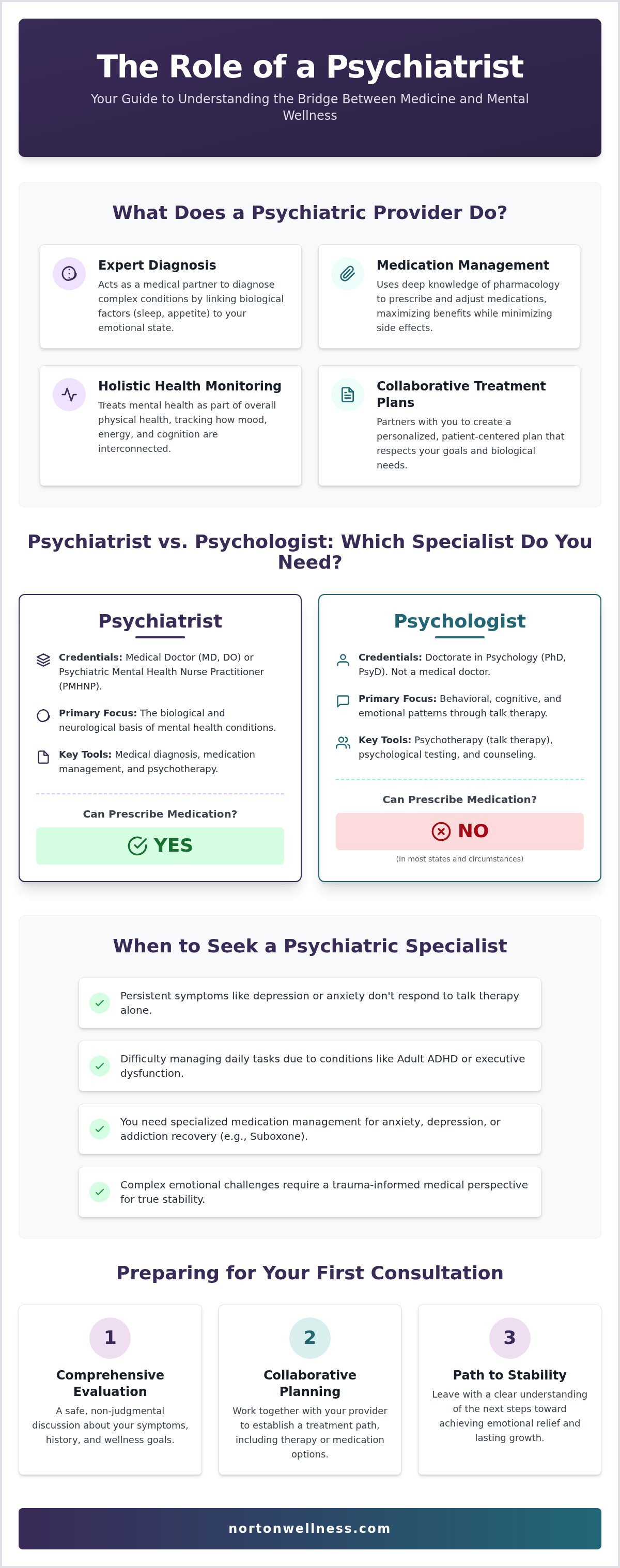
Psychiatrist vs. Psychologist: Which Specialist Do You Need?
Confusion often arises when choosing between a psychiatrist and a psychologist. It's a common hurdle for many seeking help. While both specialists are dedicated to your mental health, their methods of intervention differ significantly. A psychologist typically focuses on talk therapy and behavioral strategies to help you process emotions and develop coping mechanisms. In contrast, a psychiatric provider approaches wellness through a medical lens. When asking what does a psychiatrist do to distinguish their role, the answer lies in their ability to assess the biological and physiological factors influencing your mind.
Psychiatric providers analyze concrete biological data like sleep patterns, appetite changes, and even lab results to inform your care. They look at the architecture of your brain's chemistry. This medical perspective is essential when symptoms are so severe that they hinder your ability to engage in talk therapy effectively. By stabilizing the biological foundation, they create the mental space needed for behavioral changes to take root. This approach ensures that your treatment is as much about your physical health as it is about your emotional state.
The Medical Advantage: Prescriptive Authority
The defining characteristic of psychiatric care is prescriptive authority. This is the specialized ability to use medication as a tool for healing. When you consider what does a psychiatrist do for patients with complex needs, remember that their medical background allows them to navigate intricate health histories. For conditions like bipolar disorder or severe clinical depression, the root cause is often a neurochemical imbalance that talk therapy alone cannot fully address. A psychiatric specialist understands how to manage complex medication interactions and monitor your physical response to treatment. They ensure that your path toward stability is safe and scientifically grounded.
If you're feeling overwhelmed by symptoms that don't seem to lift with conversation alone, it might be time to explore medical support. You can schedule an appointment for psychiatric medication management to begin identifying the biological factors at play.
Collaborative Care: The Best of Both Worlds
Choosing one specialist doesn't mean you have to abandon the other. In fact, many patients find the most success through a team approach. At Norton Wellness, we don't work in isolation. We actively collaborate with your existing therapist or primary care doctor to ensure your care is cohesive and well-rounded. This synergy between medication management and behavioral therapy addresses both the biological and psychological aspects of your well-being, creating a more comprehensive safety net for your health.
A collaborative journey between medical expertise and therapeutic support is the gold standard for mental health recovery. By integrating these different forms of care, we provide a more robust defense against the challenges you face. This proactive partnership ensures that every provider on your team is moving in the same direction toward your stability and growth. We are here to act as your steady partner, ensuring you never have to navigate the complexities of mental health care on your own.
Your First Appointment: Navigating Psychiatric Care in MA and RI
Taking the first step toward professional mental health care is often the most challenging part of the recovery process. It requires a level of vulnerability that can feel overwhelming, especially when you're already managing the heavy weight of symptoms like depression or chronic anxiety. We want to make this transition as seamless as possible. Whether you're visiting our offices in New Bedford or Providence, or connecting from the comfort of your home in Fall River or Taunton, your first appointment is designed to be a collaborative conversation rather than a cold, clinical interrogation. You've already done the hard work of deciding to seek help; now, we're here to act as your steady partner.
To get the most out of your initial visit, it's helpful to come prepared with a few key pieces of information. Bringing a list of current medications, your insurance card, and a brief history of your symptoms ensures we spend our time focusing on your immediate needs. If you've ever wondered, what does a psychiatrist do during that initial hour, the answer is simple: they listen. They gather the biological and emotional pieces of your story to build a foundation for your future stability. This is the moment where your symptoms stop being a mystery and start becoming part of a manageable plan for healing.
Telehealth vs. In-Person Care
Modern life is demanding, and we believe your care should fit into your schedule, not add to your stress. For many busy adults across Massachusetts and Rhode Island, secure telehealth appointments offer a flexible way to prioritize mental health without the burden of a long commute. Our digital platform allows for a deep, personal connection while maintaining the highest standards of privacy and clinical safety. It's a modern solution for those who need high-level care but value the convenience of their own space.
However, we understand that technology isn't for everyone. If you prefer a face-to-face connection or have complex physical health considerations that require a closer look, an in-person visit at our New Bedford location provides a welcoming environment. Choosing between telehealth and in-person care is about what makes you feel most secure and heard. Both options provide the same trauma-informed, expert medication management you deserve.
A Patient-Centered Experience at Norton Wellness
Our approach at Norton Wellness is built on the philosophy of active listening and genuine partnership. We don't just see a diagnosis; we see a person ready for transformation. We've streamlined our logistics to make psychiatric care accessible and stress-free, accepting various insurance plans and offering secure online payments. When you reach out, you can expect a prompt response to coordinate your care, often within the first 24 hours. We're ready to act when you are.
The first appointment is more than just a medical evaluation; it's the start of your journey toward emotional clarity. By combining our specialized medical expertise with your unique life experience, we create a roadmap that respects your goals. Ready to start your journey? Book a psychiatric consultation with Norton Wellness today.
A Steady Partner for Your Mental Health
You deserve a life defined by clarity rather than the heavy fog of untreated symptoms. By now, you have a clearer understanding of what does a psychiatrist do to bridge the gap between biological symptoms and emotional relief. Whether you're navigating the complexities of Adult ADHD, seeking specialized addiction recovery through tools like Suboxone, or managing chronic anxiety, you don't have to carry the burden alone. Our trauma-informed, patient-centered approach ensures that your medical care is always paired with deep, empathetic validation and a focus on your unique goals.
Stability is within reach. With convenient telehealth appointments available across Massachusetts and Rhode Island, high-level psychiatric care is more accessible than ever. We're here to act as your compassionate guide, providing the expert medication management and active listening you need to thrive. Don't wait for your symptoms to become unmanageable before seeking the support you deserve. Schedule Your Compassionate Psychiatric Evaluation today and take that vital first step toward a more balanced, hopeful future. You're ready for this transformation, and we're ready to walk beside you.
Frequently Asked Questions
What is the difference between a psychiatrist and a therapist?
The primary difference is that a psychiatrist or psychiatric provider is a medical specialist with the authority to prescribe medication, whereas a therapist typically focuses on talk therapy and behavioral interventions. While therapists help you navigate emotional patterns through conversation, a psychiatric provider looks at the biological and chemical factors affecting your brain. Many people find the best results by using both specialists as a collaborative team to address mental health from every angle.
Can a psychiatrist prescribe medication during the first visit?
Yes, a psychiatric provider can prescribe medication during your first visit if they determine it's clinically appropriate after a comprehensive evaluation. This decision is based on a deep dive into your medical history, current symptoms, and your personal treatment goals. We prioritize your safety and comfort, often starting with a "low and slow" approach to ensure your body adjusts well to any new treatment plan while we monitor your progress.
How long does a typical psychiatric medication management appointment last?
A typical follow-up medication management appointment usually lasts between 15 and 30 minutes. These sessions are shorter than the initial 60-minute evaluation because they focus on monitoring your progress and adjusting your treatment as needed. We use this time to discuss any side effects, track improvements in your daily functioning, and ensure you feel supported on your path toward stability without feeling rushed or unheard.
Do I need a referral to see a psychiatrist in Massachusetts or Rhode Island?
Most patients in Massachusetts and Rhode Island don't need a formal referral from a primary care doctor to see a psychiatrist, though it depends on your specific insurance plan. It's always a good idea to check with your insurance provider to confirm your coverage details and any out-of-pocket costs. We strive to make the process as stress-free as possible, allowing you to book directly with us to start your care journey sooner.
What should I expect during a psychiatric evaluation for ADHD?
During a psychiatric evaluation for ADHD, you should expect a thorough discussion about your childhood history, current struggles with executive function, and emotional regulation. We look beyond simple focus issues to understand how symptoms impact your work and relationships. This detailed assessment helps us determine what does a psychiatrist do to tailor a medication plan that specifically addresses your unique neurobiology and your specific lifestyle needs.
Is telehealth for psychiatry as effective as seeing someone in person?
Clinical practice and research have shown that telehealth for psychiatry is just as effective as in-person visits for the majority of adults. Our secure digital platform ensures you receive the same level of compassionate, trauma-informed care and expert medication management from the comfort of your home. This flexibility makes it easier for busy adults in Fall River or Taunton to stay consistent with their treatment plans and achieve long-term wellness.
How do I know if I need medication for my anxiety or depression?
You might need medication if your symptoms of anxiety or depression are severe enough to interfere with your ability to work, maintain relationships, or handle daily tasks. If talk therapy alone hasn't provided the relief you need, it's often a sign that there's a biological component requiring medical support. Understanding what does a psychiatrist do can help you see medication as a vital tool to stabilize your brain chemistry so you can engage fully in your life again.
Does Norton Wellness accept insurance for psychiatric services in New Bedford?
Norton Wellness accepts various insurance plans for psychiatric services at our New Bedford location and for our telehealth appointments across the region. We also offer secure online payment options to keep the logistics of your care as simple as possible. Because insurance networks can change, we recommend contacting us directly to verify that your specific plan is currently accepted before your first consultation to avoid any financial surprises.


